Forces in Physics
What are Forces in Physics?
A force quantitatively describes the interaction between two physical systems. In physics, a force is defined as any influence that causes an object to undergo a change in motion. Mathematically, force is a vector quantity characterized by both magnitude and direction.
For example, when you pull a box across the floor or push a table, you are exerting forces. The weight of an object represents the gravitational force exerted by Earth on that object. Forces can act through direct contact or at a distance via fields.
According to Newton's Third Law, forces always exist in action-reaction pairs:
$$\vec{F}_{\text{action}} = -\vec{F}_{\text{reaction}}$$
These equal but opposite forces act on different objects.
Since forces possess both magnitude and direction, they are represented mathematically as vectors:
$$\vec{F} = (F_x, F_y, F_z) \quad \text{or} \quad \vec{F} = F\hat{n}$$
where $\hat{n}$ is a unit vector indicating direction.
The SI unit of force is the newton (N), defined as:
$$1 \, \text{N} = 1 \, \text{kg} \cdot \text{m/s}^2$$
Thus, one newton is the force required to accelerate a one-kilogram mass by one meter per second squared.
Classification of Forces
Forces can be categorized into two fundamental classes based on their mode of interaction:
A) Contact Forces
These require physical contact between interacting objects:
- The pushing force exerted by a person on a trolley
- The tension force transmitted through a string supporting a suspended object
- The normal force exerted by a surface on an object resting upon it
B) Field Forces (Action-at-a-Distance)
These act through space without direct physical contact:
- Gravitational force between masses: $F_g = G\frac{m_1 m_2}{r^2}$
- Magnetic force between magnets or moving charges
- Electrostatic force between charges: $F_e = k\frac{q_1 q_2}{r^2}$
Types of Forces in Physical Systems
-
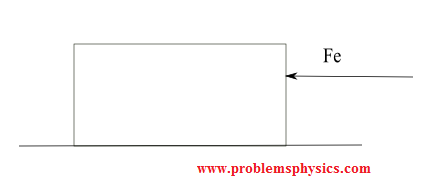
Applied External Force
Any force applied to an object by an external agent (human, animal, machine, or another object). For example, a person pushing a box applies an external force to overcome inertia and/or friction.
-
Gravitational Force (Weight)
The attractive force exerted by a planetary body on objects with mass. Near Earth's surface:
$$W = mg$$
where $g \approx 9.8 \, \text{m/s}^2$ is gravitational acceleration.

-
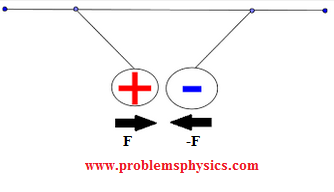
Electric Force on a Charge
The force experienced by a charged particle in an electric field $\vec{E}$:
$$\vec{F}_e = q\vec{E}$$
Between point charges, Coulomb's Law applies:
$$\vec{F}_e = k\frac{q_1 q_2}{r^2}\hat{r}$$
-
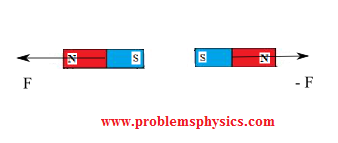
Magnetic Force
The force exerted on a moving charge or current-carrying conductor in a magnetic field $\vec{B}$:
$$\vec{F}_m = q(\vec{v} \times \vec{B}) \quad \text{or} \quad \vec{F}_m = I(\vec{L} \times \vec{B})$$
for a current $I$ in conductor length $L$.
-
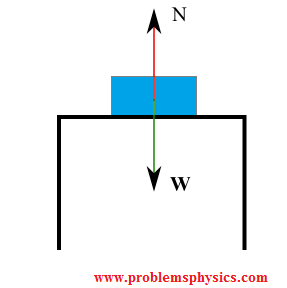
Normal Force
The perpendicular contact force exerted by a surface to support the weight of an object resting on it. For a horizontal surface:
$$N = mg \cos\theta$$
where $\theta$ is the surface incline angle (0° for horizontal).
-
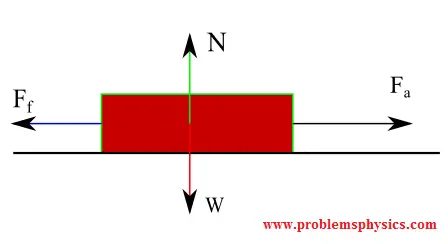
Force of Friction
The resistive force opposing relative motion between surfaces in contact. Two primary types exist:
- Static friction: $f_s \leq \mu_s N$, prevents motion initiation
- Kinetic friction: $f_k = \mu_k N$, opposes ongoing motion
where $\mu_s$ and $\mu_k$ are coefficients of friction.
-
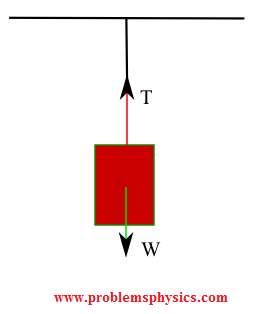
Tension in Strings, Ropes, and Cables
The pulling force transmitted through flexible connectors. For a massless, inextensible string, tension remains constant throughout:
$$T = \text{constant along string}$$
In massive strings, tension varies with position.
-
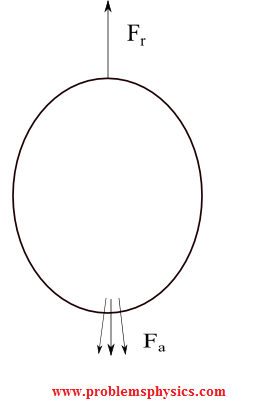
Reaction Force (Newton's Third Law)
For every action force, there exists an equal and opposite reaction force acting on different bodies:
$$\vec{F}_{AB} = -\vec{F}_{BA}$$
Example: A balloon moves upward as air rushes downward.
-
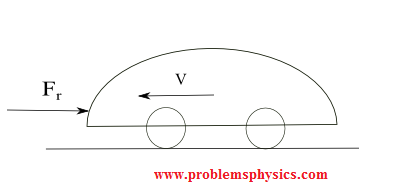
Air Resistance (Drag Force)
The frictional force exerted by air on moving objects, generally opposing motion. For low speeds:
$$F_d \approx -bv$$
For high speeds:
$$F_d \approx -\frac{1}{2}C\rho Av^2$$
where $C$ is the drag coefficient.
-
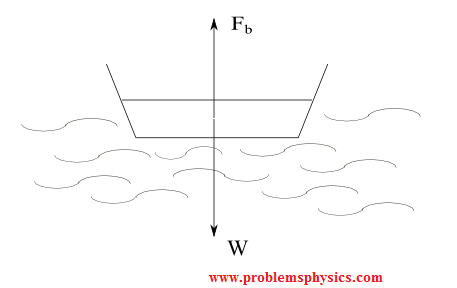
Buoyancy (Upthrust Force)
The upward force exerted by a fluid (liquid or gas) on an immersed object, described by Archimedes' principle:
$$F_b = \rho_{\text{fluid}} V_{\text{displaced}} g$$
This explains flotation and apparent weight reduction in fluids.