Displacement and Distance: Problems with Solutions
This page contains problems on the fundamental concepts of displacement and distance in physics. Solving these will help you clearly distinguish between the two.
Key Definitions:
-
Distance is a scalar quantity that refers to the total length of the path traveled by an object, regardless of its starting or ending point. It is always positive.
-
Displacement is a vector quantity that refers to the net change in position of an object. It is defined as the straight-line vector from the initial position to the final position. Its magnitude is the shortest distance between these two points.
For motion along a straight line, if an object moves from position \( x_1 \) to position \( x_2 \), its displacement is given by \( \Delta x = x_2 - x_1 \). The distance traveled is the sum of the lengths of all segments of its path.
Problem 1
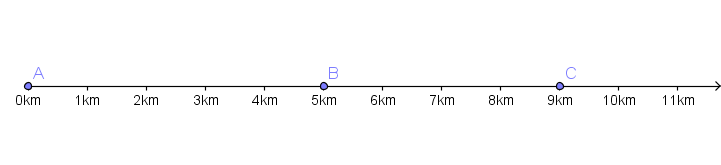
An object moves from point A to point B to point C, then back to point B and finally to point C along the line shown in the figure below.
a) Find the total distance covered by the object along its entire journey.
b) Find the magnitude and direction of the object's overall displacement.
 Solution to Problem 1
Problem 2
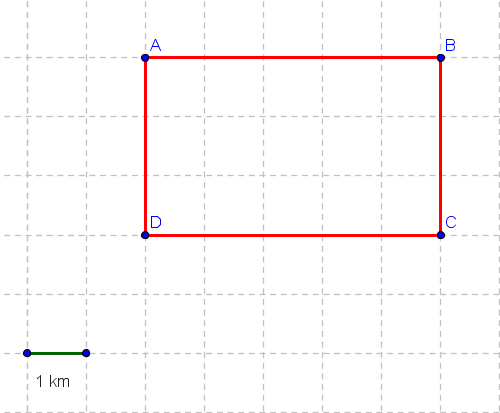
An object moves from point A to point C along the perimeter of the rectangle shown in the figure below.
a) Find the distance covered by the object.
b) Find the magnitude of the object's displacement (the length of the straight line from A to C).
 Solution to Problem 2
Problem 3
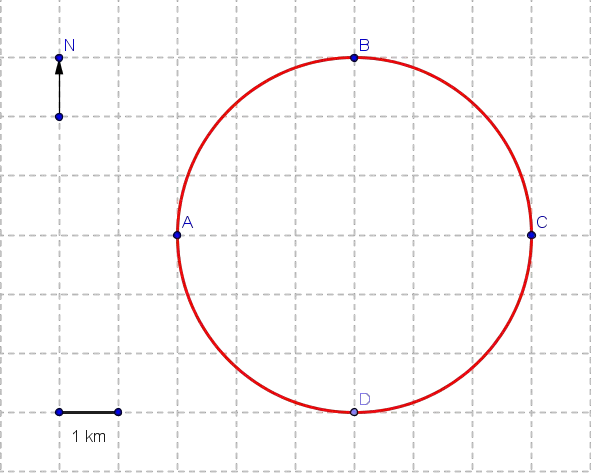
An object moves from point A to B to C to D and finally back to A along the circle shown in the figure below.
a) Find the total distance covered in one full revolution.
b) Find the magnitude and direction of the displacement after the object returns to its starting point A.
 Solution to Problem 3
Problem 4
An object moves from point A to B to C to D along the circle shown in the figure below (a three-quarter arc).
a) Find the distance covered.
b) Find the magnitude of the displacement (the straight line from A to D).
Solution to Problem 4
Problem 5
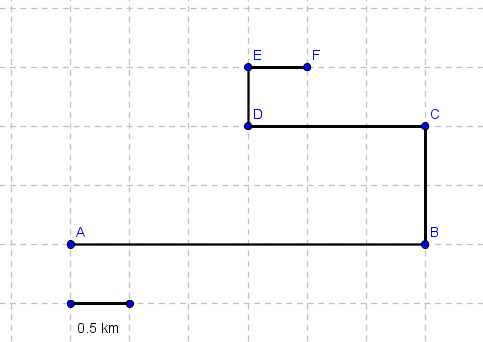
An object moves along the grid through points A, B, C, D, E, and F as shown below.
a) Find the total distance traveled along the path A→B→C→D→E→F.
b) Find the magnitude of the overall displacement (from A to F).
 Solution to Problem 5
More References and Links